
Discover how a strategic visual overhaul can transform a legacy fast-food chain into a lifestyle icon for the digital generation. If you are a brand manager or entrepreneur aiming to refresh your identity, understanding this pivot provides a masterclass in modernization. Taco Bell’s shift to a simplified purple bell icon wasn’t just a cosmetic update; it was a calculated move by Lippincott to align the visual identity with the “Live Mas” campaign and ensure scalability across mobile screens.
Here are the core elements of this transformation:
- The transition from a “Jester” to an “Explorer” brand archetype.
- How minimalism improves brand recognition on small mobile screens.
- The strategic use of purple to disrupt a market dominated by red and yellow.
- Why stripping away 90s nostalgia was necessary for future growth.
The Strategic Shift: From Cheap Food to “Live Mas”
Taco Bell had a problem in the early 2010s. For years, it positioned itself as the cheap alternative to burgers, relying on the “Think Outside the Bun” slogan. This worked for a while, but it trapped the brand in a “Jester” archetype—fun, but not serious or aspirational. Industry analysis indicates that to grow, the brand needed to evolve into an “Explorer” archetype. This meant moving beyond just selling food as fuel. They wanted to sell an experience.
The “Live Mas” campaign became the vehicle for this change. It wasn’t just about tacos anymore; it was about lifestyle, youth culture, and trying new things. I find this pivot fascinating because it required the visual identity to match the new philosophy. You cannot sell a modern, adventurous lifestyle with a logo that looks like a relic from a 1990s cartoon. The old logo, with its busy colors and heavy drop shadows, felt cheap. The new direction demanded something sharper.
Analyzing the Lippincott Redesign: Why Minimalism Wins
In 2016, Taco Bell partnered with the creative consultancy Lippincott to execute this massive visual identity refresh. The result was a shock to many fans. They stripped away the teal, the bright yellow, and the faux-3D effects. What remained was a flat, clean purple bell against a white or black background.
This was a risky move. People hate change, especially when it involves childhood nostalgia. However, from a design perspective, it was brilliant. The previous logo was a “visual hairball”—too messy for the clean lines of modern apps and websites. By flattening the design, Lippincott ensured the logo looked crisp on everything from a giant billboard to a tiny app icon on an iPhone.
Why this works:
- Scalability: Complex gradients disappear on small screens. Flat shapes remain legible.
- Flexibility: The simplified bell can be filled with patterns or textures for different campaigns without losing its shape.
- Maturity: It signaled that the brand was growing up. It was no longer just a late-night pit stop; it was a legitimate dining choice.
The Psychology of Purple: Owning a Color Lane
Look at the fast-food industry. McDonald’s, Wendy’s, Burger King, In-N-Out—they all rely heavily on red and yellow. These colors supposedly trigger hunger. Taco Bell, however, doubled down on purple.
In the 2016 redesign, they made purple the hero. This was a genius stroke of differentiation. In a sea of red and yellow, the purple bell icon pops immediately. Color psychology suggests purple often represents creativity, wisdom, and luxury. While “luxury” might seem like a stretch for a taco chain, it creates a subconscious perception of being “special” or “different” from the burger crowd.
I believe this color choice is the single strongest asset in their visual toolkit. It communicates “freshness” not through the literal green of lettuce, but through the freshness of ideas. It tells the consumer, “We are the alternative.”
Digital-First Adaptation: Preparing for the App Era
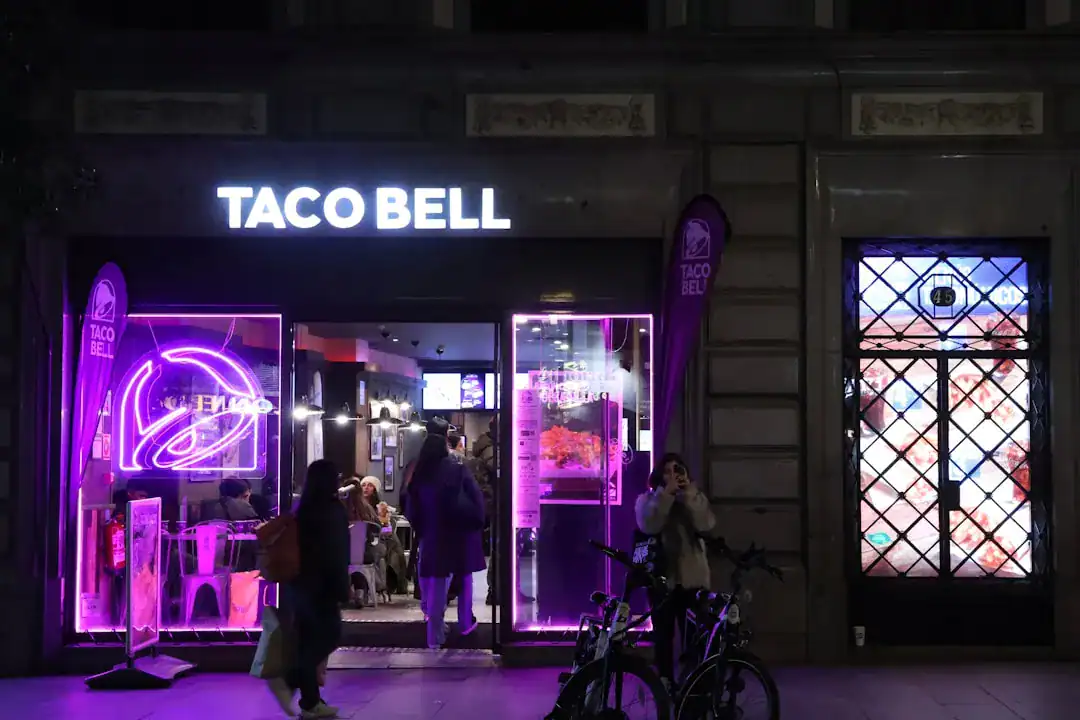
We often overlook the practical reasons behind a rebrand. In 2016, the world was moving to mobile-first ordering. A complicated logo with fine details is a nightmare for UI/UX designers. It loads slower as an image file and looks muddy at 50 pixels wide.
The new Taco Bell logo was built for the digital ecosystem. The “Live Mas” campaign relies heavily on social media engagement, user-generated content, and app interactions. A clean, vector-based icon integrates seamlessly into these platforms. It acts as a digital stamp.
Data from similar market shifts shows that brands simplifying their logos for digital use often see improved engagement metrics simply because their branding is more legible in the feed. Taco Bell didn’t just redesign a logo; they optimized their interface with the customer.

Navigating Backlash and Ensuring Consistency
When the new logo dropped, the internet reacted as it always does—with memes and complaints. Critics called it “bland” and “soulless,” comparing it to a generic tech company logo. This is a common hurdle in brand modernization strategies.
But here is the truth: initial backlash rarely hurts long-term equity if the strategy is sound. Taco Bell stuck to its guns. They rolled out the new identity consistently across packaging, store interiors, and digital channels. Over time, the “bland” logo became the new normal. It allowed the food photography and the wild marketing stunts to take center stage. The logo became a confident anchor rather than a distracting decoration.
This consistency is key. A logo is just a symbol; the repetition of that symbol creates the trust. By sticking with the simplified purple bell, Taco Bell successfully retrained the consumer’s eye to associate that specific shape and color with their modern “Live Mas” identity.
Conclusion and Actionable Suggestions
The Taco Bell rebranding teaches us that effective design is about future-proofing, not just aesthetics. They sacrificed nostalgia to gain relevance with a digital-native audience. The purple bell icon now stands as a symbol of agility in a rigid industry.
If you are planning a visual refresh, consider these steps:
- Audit for Digital: Check if your current logo is legible at 20mm size on a phone screen. If not, simplify.
- Own Your Color: Don’t just copy competitors. Find a color space that your brand can dominate.
- Align with Archetype: Ensure your visual identity matches your brand’s character. If you are an “Explorer,” look the part.
- Ignore the Noise: Expect initial resistance to change. Focus on the long-term utility of the design.
- Use Efficient Tools: You don’t always need a multimillion-dollar agency for a professional look. Tools like Ailogocreator allow businesses to experiment with minimalist, scalable designs that align with modern standards.
FAQ
Why did Taco Bell change its logo in 2016?
Taco Bell updated its logo to align with the “Live Mas” lifestyle campaign and to ensure the design was scalable for digital platforms like mobile apps and social media. The previous design was too complex for modern screen requirements.
What does the purple bell represent?
The purple bell differentiates Taco Bell from the sea of red and yellow fast-food chains. It symbolizes creativity, youthfulness, and an “outsider” status that appeals to their target demographic of millennials and Gen Z.
Who designed the new Taco Bell logo?
The 2016 rebranding was executed by the internal design group at Taco Bell in partnership with the global creative consultancy Lippincott.
Is the Taco Bell logo minimalist?
Yes, the current logo is a prime example of minimalist design. It removes gradients, drop shadows, and multiple colors in favor of a flat, two-tone design that is flexible and easy to recognize.
Did the Taco Bell rebrand affect sales?
While direct causation is hard to isolate, the rebrand coincided with a period of growth and successful product launches. The modernized look helped the brand stay relevant and connect with a younger audience, contributing to long-term brand equity.
CommentsTake the first comment