
You can significantly increase customer loyalty by trading sterile corporate aesthetics for the human touch of hand-drawn elements. If you are a brand strategist or designer aiming to humanize a business, Wendy’s evolution offers a masterclass in balancing global scale with intimacy. In the cutthroat world of fast food branding, Wendy’s visual identity stands out by leveraging emotional design and brand warmth to bypass logic and appeal directly to feelings. Through the strategic use of hand-drawn typography and custom illustrations, they have successfully transformed the perception of a massive chain into something that feels like a neighborhood kitchen.
- Personalization: Hand-drawn fonts act like a signature, creating a subconscious bond of trust.
- Color Psychology: Strategic use of red and yellow evokes comfort and happiness, not just urgency.
- Authenticity: Visuals rooted in a founder’s legacy create a mental model of quality.
- Differentiation: Custom illustrations separate the brand from the “greasy” aesthetic of competitors.
The Psychology of the “Signature” Typography
When Wendy’s rebranded in 2013, they didn’t just clean up their act; they fundamentally changed the conversation with their customers. I remember seeing the old logo—blocky, western-style letters that screamed “1970s roadside stop.” It was functional, but it wasn’t emotional. The shift to the current script-like typography was a brilliant move in emotional design.
The new font looks handwritten. In graphology and design psychology, a handwritten script suggests a person is behind the brand, not a machine. It feels like a signature—specifically, the signature of the founder, Dave Thomas, or the mascot herself. According to design analysis, this “flawed” or organic lettering style removes the corporate barrier. It signals that the food is prepared by hands, not processed by robots.
For any business, the lesson here is clear: perfection can be alienating. If you want brand warmth, your typography should invite the customer in rather than shouting at them from a billboard. The script feels casual and approachable, aligning perfectly with the brand’s desire to be seen as a “cut above” standard fast food while remaining accessible.
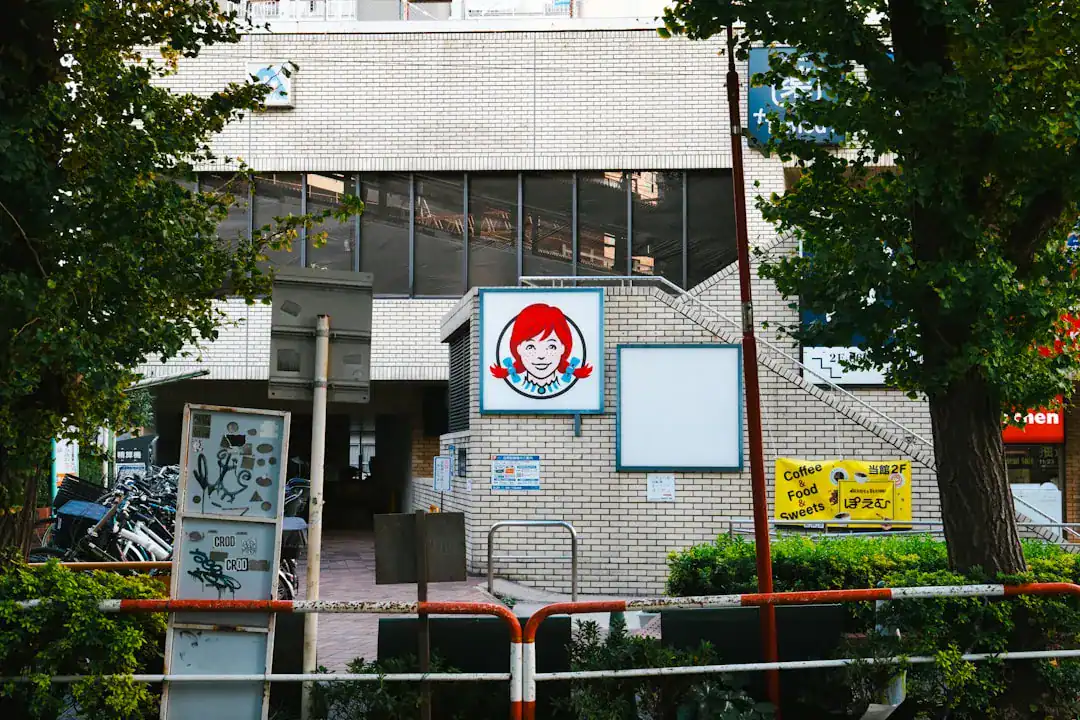
Color Palettes That Hug Instead of Yell
We all know the fast-food rule: red and yellow trigger hunger. But Wendy’s application of these colors offers a nuanced take on fast food branding. While competitors use these colors to create anxiety and speed (get in, eat, get out), Wendy’s utilizes a brighter, more open variation to evoke happiness.
Industry experts note that yellow is deeply associated with sunshine, warmth, and optimism. By pairing a vibrant yellow with a clean white background—rather than the cluttered patterns used in the 80s—Wendy’s allows the color to breathe. This creates a sense of freshness. The red is not just an alarm signal; it represents the “pigtails” and the heart of the brand.
I find it fascinating how they integrated cool blues into their broader style guides. As noted in their global visual design strategies, the introduction of blue adds a layer of professionalism and “freshness” that purely warm palettes lack. This balance prevents the brand from feeling cheap. It creates a visual environment where Wendy’s visual identity feels more like a fast-casual dining experience than a grease pit.
Anchoring Visuals in Human Legacy
Authenticity is a buzzword, but Wendy’s actually backs it up with their visual assets. The logo isn’t a random cartoon; it is a stylized portrait of a real person (Dave Thomas’s daughter). This is a powerful “mental model” in psychology. When consumers see a face, especially a smiling child, it triggers a biological response of trust and care.
Marketing psychologists point out that by invoking the founder’s legacy through custom illustrations of the mascot, the brand creates a narrative of continuity. They aren’t just selling burgers; they are selling a philosophy of “old-fashioned” quality.
The evolution of the mascot is telling. The original was detailed and Victorian. The current version is simplified and modern, yet it retains the essential human characteristics. This continuity tells the customer, “We changed with the times, but our values (the beef) remained the same.” It is a textbook example of how to maintain brand warmth during a corporate modernization.

Differentiating Through Wit and Illustration
Wendy’s social media presence is legendary for its “roasts,” but the visual accompaniment to this voice is equally important. They often employ custom illustrations and flat design styles that feel internet-native rather than corporate-approved.
Competitors often rely heavily on hyper-realistic, glistening photos of burgers that never look like the real thing. This creates a “reality gap” that breeds cynicism. Wendy’s, by leaning into stylized graphics and a strong red-and-white visual language, sets a tone of honesty. They acknowledge the medium they are playing in.
I believe this approach works because it respects the intelligence of the consumer. It says, “We know this is marketing, let’s have fun with it.” This builds a stronger emotional connection than any fake photo of a salad ever could. The visual language supports the “challenger” personality of the brand, making them feel like the spunky underdog despite their massive size.
Democratizing High-End Brand Design
Historically, achieving this level of visual sophistication—where hand-drawn nuances meet scalable vector graphics—required a team of agency designers and months of billing. Small businesses often settled for generic clipart that lacked soul.
Today, the landscape has shifted. Technology has democratized access to sophisticated design principles. Tools like Ailogocreator allow entrepreneurs to generate logos that incorporate these exact elements of hand-drawn typography and emotional color theory without the agency price tag. By using intelligent algorithms, these platforms can suggest font pairings and icon styles that mimic the “human touch” Wendy’s spent millions perfecting. It is now possible for a local coffee shop or a startup to project that same level of brand warmth and professional polish instantly.
FAQ
Why does hand-drawn typography improve brand perception?
Hand-drawn or script fonts mimic human handwriting, which subconsciously signals personalization, care, and authenticity. It breaks down the barrier between a faceless corporation and the consumer.
What is the core principle of emotional design in branding?
Emotional design aims to elicit a specific feeling (like joy, trust, or nostalgia) rather than just conveying information. It focuses on how the brand makes the user feel before they even interact with the product.
How does Wendy’s use of red differ from other fast-food chains?
While many chains use red to create urgency and impulse, Wendy’s pairs it with ample white space and friendly typography to evoke warmth and love, leveraging the “heart” association of the color.
Why are custom illustrations better than stock photos?
Custom illustrations allow a brand to control the narrative and tone completely. They are unique to the brand’s identity, whereas stock photos can be used by anyone, leading to a generic and forgettable look.
Conclusion and Actionable Suggestions
Wendy’s success proves that even a giant corporation can feel like a friend if the visual identity is crafted with empathy. By prioritizing emotion over cold efficiency in their design choices, they have secured a unique spot in the market.
If you are looking to inject this level of warmth into your brand, consider these steps:
- Audit Your Fonts: Replace sterile sans-serif headers with a typeface that has some “hand” or imperfection to it.
- Open Up the Palette: Don’t just stick to primary colors; add a neutral background (like white or cream) to let your brand colors breathe.
- Humanize Your Icon: If you use a mascot or symbol, ensure it feels like a character with a story, not just a stamp.
- Use Illustrations for Storytelling: Replace generic stock imagery with custom graphics that match your brand’s voice.
- Leverage Smart Tools: Utilize resources like Ailogocreator to rapidly prototype different emotional design styles to see what resonates with your audience.
References:
- Source 1: LinkedIn – How Wendy’s “Where’s the beef?” became a cultural phenomenon
- Source 2: Oreate AI – The Psychology Behind Wendy’s Iconic Yellow Packaging
- Source 3: Taylor Sniffen – The Effects of Color and Typography on Emotion in Branding
- Source 5: Joshua Kennon – Wendy’s Brilliantly Relies on Mental Models
- Source 8: Oreate AI – Wendy’s Logo Evolution: From Classic to Contemporary
- Source 9: Patrick Hayslip – Wendy’s Style Guide
- Source 15: Behance – Wendy’s Projects :: Photos, videos, logos, illustrations
References & Sources
- User engagement with a popular food brand before, during and after … (pmc.ncbi.nlm.nih.gov)
- [PDF] Strategic & Management Analysis of Wendy’s Co. (scholarworks.umt.edu)
- [PDF] Strategic Analysis of Wendy’s – CORE (files01.core.ac.uk)
- [PDF] Leveraging healthy restaurant brands with handwritten typeface (e-tarjome.com)
- Handwriting: The foodie font of love – Ohio State News (news.osu.edu)
CommentsTake the first comment