
Stripping your brand of its name is perhaps the ultimate gamble in marketing, but when executed correctly, it transforms a simple logo into a cultural icon. If you are a business owner or design strategist aiming to future-proof your visual identity, understanding this transition is non-negotiable. The journey of the Starbucks Siren from a cluttered coffee seal to a minimalist green totem offers a masterclass in corporate rebranding and the power of debranding strategy. By analyzing this Starbucks logo evolution, we can see how removing text actually amplifies a brand’s voice in a noisy digital world.
- The Power of Omission: How removing the company name signaled global dominance.
- Visual Equity: Why the Starbucks Siren works better as a standalone symbol than a labelled crest.
- Digital Adaptability: The role of mobile screens in driving minimalist logo design.
- Timing is Everything: Why early-stage startups should not copy this strategy immediately.
The Evolution of the Siren: Shedding the Shell
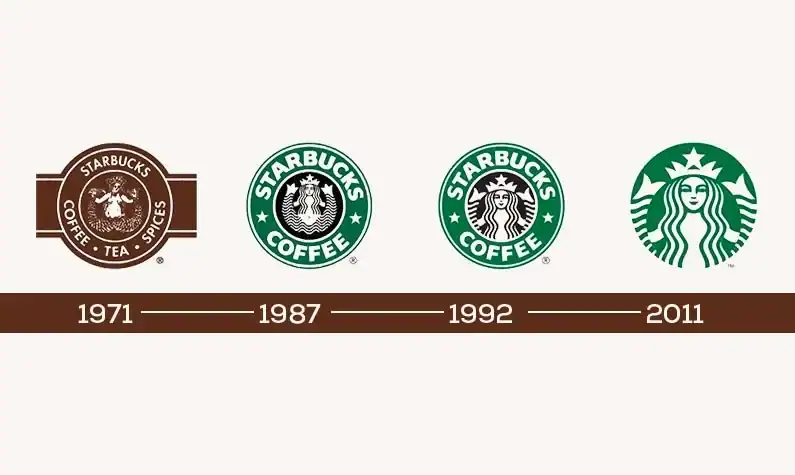
I find the history of the Starbucks logo fascinating because it reads less like a design iteration and more like a striptease of corporate shedding. In 1971, the original logo was a complex, brown, woodcut-style illustration of a twin-tailed mermaid. She was bare-chested and encircled by the text “Starbucks Coffee, Tea, and Spice.” It was authentic, sure, but it was also visually heavy.
By 1987, the brand introduced its signature “Kelly Green,” cleaning up the lines and covering the siren’s chest with flowing hair. Then came 1992, where they zoomed in on the face, cropping the tails. But the real earthquake happened in 2011. To mark their 40th anniversary, Starbucks removed the outer ring, erased the stars, and deleted the words “Starbucks Coffee.”
This wasn’t just a cleanup; it was a declaration. The brand had become so ubiquitous that it no longer needed to introduce itself. According to industry analysis, this move shifted the logo from being a label (telling you what it is) to a symbol (telling you how to feel). It freed the visual brand identity from the constraints of the word “Coffee,” allowing the company to expand into food, merchandise, and lifestyle products without contradiction.
De-textualization as the Ultimate Power Move
In my observation of the tech and retail sectors, dropping the brand name is a flex that only the giants can afford. It signals a level of confidence that borders on arrogance—in a good way. When you see the Golden Arches, the Apple silhouette, or the Nike Swoosh, you don’t need text to know who they are.
The 2011 debranding strategy placed Starbucks in this elite club. Industry reports from the time suggest that while the move was initially met with skepticism (remember the backlash against Gap’s logo change?), it succeeded because the Starbucks Siren had already accrued decades of emotional equity.
By removing the text, Starbucks forced consumers to engage with the image itself. The Siren became a “Green Totem”—a symbol of the “Third Place” between work and home. Text is processed by the reading part of the brain; images are processed by the emotional part. By removing the barrier of language, the logo became universally understood, transcending English to appeal directly to markets in China, Japan, and beyond without translation.
Minimalism in the Mobile Era
We cannot discuss this minimalist logo design without addressing the device in your pocket. In 2011, the smartphone revolution was exploding. Complex, text-heavy logos turn into unreadable smudges when shrunk down to the size of an app icon.
I argue that the Starbucks corporate rebranding was largely driven by this digital necessity. The 2011 Siren is symmetrical, clean, and scalable. It looks as good on a 50-foot billboard as it does on a 50-pixel push notification.
Market data indicates that brands engaging in “de-textualization” see better engagement rates on mobile platforms because the visual load is lighter. A face is easier to recognize in a split second than a word. This shift toward visual brand identity over textual identity is a direct response to our shrinking attention spans.
The Cost of Simplicity: Why It’s Harder Than It Looks
Many entrepreneurs look at the Starbucks logo and think, “I should make my logo just a simple icon, too.” I often have to stop them. Simplicity is expensive. It requires years of association before a shape equals a name in the customer’s mind.
Creating a logo that is simple yet distinct is incredibly difficult. In the past, you needed a six-figure budget and a boutique agency to refine a symbol like the Siren. Today, the landscape has changed. Advanced AI tools have democratized this high-level design capability. Platforms like Ailogocreator now allow founders to experiment with minimalist, icon-centric designs that follow these modern principles of clarity and adaptability. While you might not have 40 years of history yet, you can certainly start with a visual foundation that is ready for the digital age.
The lesson here is not just to “delete text.” It is to refine the core visual asset until it can stand on its own. Starbucks didn’t just delete the name; they refined the Siren’s face, making her more symmetrical and “human” to ensure she could carry the brand alone.

When to Simplify: The Maturity Benchmark
The biggest mistake I see in modern branding is “premature minimalism.” Starbucks waited 40 years before dropping their name. They earned the right to be a wordless icon.
If you are a new brand, you need your name attached to your logo. You need that association. The Starbucks logo evolution teaches us patience.
- Stage 1 (1971-1987): Descriptive. Tell them who you are and what you sell.
- Stage 2 (1987-2011): Associative. Link the name with a specific color and icon.
- Stage 3 (2011-Present): Iconic. Remove the training wheels.
Attempting to jump to Stage 3 without doing the work of Stage 1 and 2 is a recipe for obscurity. The success of the Starbucks Siren lies in the fact that the company waited until the market was saturated with their presence before making the switch.

Conclusion and Actionable Suggestions
The transition from a detailed coffee crest to a minimalist Green Totem is more than a design trend; it is a strategic business maneuver. It allowed Starbucks to break free from the “coffee” label and become a lifestyle brand. For observers of tech and design, the takeaway is clear: clarity conveys confidence.
If you are looking to apply these lessons to your own brand strategy:
- Audit Your Visual Assets: Check if your logo is legible at 20 pixels wide. If not, it is too complex.
- Don’t Rush Debranding: Keep your brand name locked to your logo until you have significant market penetration.
- Focus on a Singular Icon: Build equity in a mascot or symbol (like the Siren) early on, so you have the option to stand alone later.
- Prioritize Mobile First: Design your visual brand identity for screens, not just storefronts.
- Refine, Don’t Reinvent: When rebranding, try to simplify existing elements rather than changing them entirely to maintain customer recognition.
FAQ
Why did Starbucks remove the text from their logo in 2011?
They removed the text to signal that they were no longer just a coffee company. By dropping “Starbucks Coffee,” they gave themselves the flexibility to sell food, tea, and merchandise, while also making the logo more adaptable for digital platforms.
Is the Starbucks Siren a mermaid?
Technically, she is a twin-tailed siren from Norse mythology, not a traditional mermaid. The original 1971 design was based on a 16th-century Norse woodcut, intended to reflect the maritime history of Seattle and the seductive nature of coffee.
Does a text-less logo work for small businesses?
Generally, no. Text-less logos work for global giants like Apple or Nike because they have billions of dollars in brand equity. Small businesses usually need the name present to build that initial recognition.
What is the psychological effect of the green color in the Starbucks logo?
The specific shade of “Kelly Green” is associated with freshness, growth, and relaxation. It reinforces the brand’s “Third Place” philosophy—a distinct environment between work and home where customers can unwind.
How does the Starbucks logo fit into modern minimalist design trends?
It is a prime example of “flat design.” By removing shadows, complex textures, and text, the logo became a flat, scalable vector that loads instantly on websites and looks crisp on any screen resolution.
CommentsTake the first comment