
Mastering the geometry of a circular logo can transform a static brand mark into a dynamic emotional trigger that pulls consumers in like gravity. If you are a design professional or a business owner planning a visual overhaul, understanding the physics behind Pepsi’s branding journey is essential. From the controversial “gravitational field” theory to the latest bold Brand identity refresh, the Pepsi logo evolution offers a complex case study in balancing mathematical precision with human approachability.
- Geometric Precision: How the Golden ratio logo concept creates subconscious aesthetic appeal.
- Emotional Resonance: The psychology behind the “smile” hidden in the Pepsi globe meaning.
- Visual Weight: Balancing typography and iconography within a Circular logo design.
- Future-Proofing: Why the latest redesign returns to bold simplicity for the digital age.
The Gravity of Design: When Geometry Meets Emotion
I still remember the collective gasp—and the subsequent internet frenzy—when the 2008 Pepsi design analysis documents leaked. It wasn’t just a logo change; it was a thesis on the universe. The design agency, Arnell Group, didn’t just draw a circle; they claimed to channel the Earth’s magnetic fields and the “gravitational pull” of the brand.
While some dismissed it as marketing fluff, I see a fascinating attempt to ground a consumer brand in absolute mathematical truths. The design relies heavily on the Golden Ratio (approx. 1.618). By constructing the logo using circles of specific diameters (d and a) rooted in this ratio, the designers aimed to create a “breathtaking” aesthetic geometry.
This approach teaches us that a Circular logo design is rarely just a circle. It is a container of tension and balance. The “gravitational” pull they described is essentially visual weight—how the eye is drawn to the center and held there. When you look at the 2008 logo, the white band isn’t a static wave; it is a variable curve that changes thickness, creating movement. It feels like it is rotating, reacting to an invisible force. This dynamic balance is what separates a flat icon from a living brand mark.
The Smile Theory: Psychology Behind the Curve
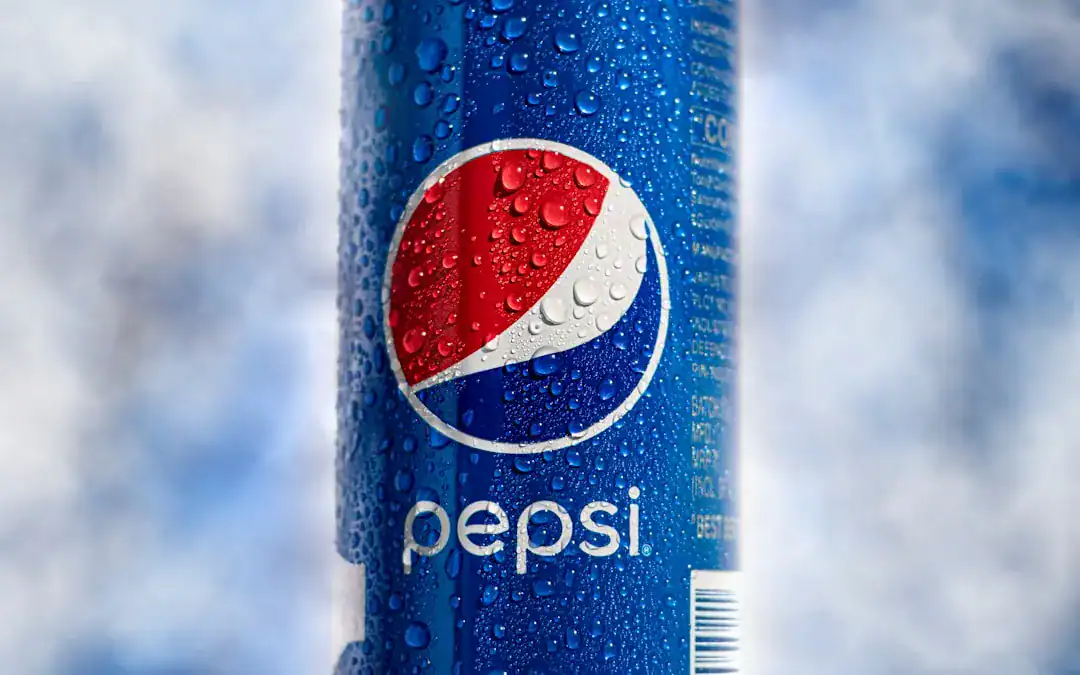
Let’s be honest, the “gravitational” talk was high-concept, but the consumer just saw a smile. This was intentional. The variable width of the white band in the “globe” was designed to represent different degrees of a smile, from a subtle smirk to a wide grin.
In my analysis of the Pepsi globe meaning, this “smile” is the bridge between cold geometry and warm emotion. A perfect circle can feel distant, robotic even. By slicing the circle with a non-symmetrical wave that flares upward, the design mimics the human facial muscle movement of a smile.
- The Upper Half: Represents the eyes or the “head” of the brand—intellect and future focus.
- The White Band: The smile itself—energy and openness.
- The Lower Half: The foundation—grounding the energy.
This specific curve does a lot of heavy lifting. It humanizes the corporation. Industry data suggests that logos with curved, upward-trending lines are perceived as friendlier and more trustworthy. The Pepsi logo evolution proves that you don’t need a mascot to smile at your customers; your geometry can do it for you.
Back to the Future: The 2023 Pulse and Balance
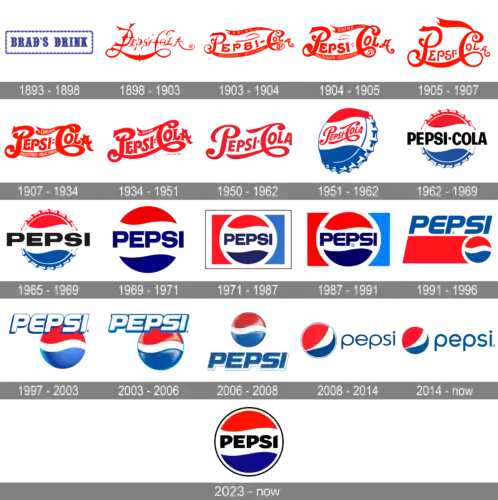
Fast forward to the recent 2023 Brand identity refresh, and we see a pivot that I find incredibly smart. The brand moved away from the minimalist, isolated “smile” of 2008 and placed the wordmark back inside the globe.
Why? Because gravity works best when there is a core.
The previous design separated the text from the icon, which often left the word “Pepsi” floating awkwardly in the negative space. The new design locks the text into the center of the circle, creating a “pulse.” This visual heartbeat radiates outward. It is bold, unapologetic, and uses black (signifying Zero Sugar) to cut through the visual noise.
This shift tells me that while the Golden ratio logo principles of 2008 were intellectually sound, they lacked practical impact in a digital-first world. On a tiny smartphone screen, you need contrast and containment. The new “pulse” design concentrates the brand’s visual gravity into a single, punchy point. It creates a “bullseye” effect that captures attention instantly—a critical trait for modern Circular logo design.
Efficiency in Modern Design: The AI Advantage
Analyzing these million-dollar design documents makes one realize how complex achieving “simple” balance actually is. Calculating golden ratios, adjusting curvature for optical weight, and ensuring the text creates a stable center of gravity used to take months of manual drafting.
I have noticed a significant shift in how we approach this today. We no longer need a 27-page document to justify a curve. Advanced tools now democratize this level of precision. Platforms like Ailogocreator allow creators to generate logos that automatically adhere to principles of balance and visual weight. These intelligent systems analyze millions of design permutations to ensure that a Circular logo design doesn’t feel lopsided or “off.”
For a startup or a mid-sized brand, this is a game-changer. You can achieve that “gravitational pull”—where the logo feels solid and established—without hiring a theoretical physicist. It is about letting technology handle the math so you can focus on the emotion.
FAQ
Q: Did the Golden Ratio really improve the Pepsi logo?
A: Aesthetically, yes. The Golden Ratio creates natural, pleasing proportions that the human eye finds comfortable. However, the complex explanation behind it (gravitational fields) was largely seen as over-justification, even if the visual result was solid.
Q: Why did Pepsi put the text back inside the circle in 2023?
A: To improve brand recall and versatility. By locking the name inside the Pepsi globe, the logo becomes a self-contained unit (a “sticker” style) that works better on digital profiles, merchandise, and packaging compared to the disjointed 2008 version.
Q: What is the significance of the black color in the new logo?
A: The black specifically highlights Pepsi Zero Sugar. It adds a modern, edgy contrast to the classic red and blue, signaling a commitment to healthier options while giving the Brand identity refresh a sharper, more aggressive visual profile.
Q: Can a circular logo be effective without text inside?
A: Yes, but it requires massive brand recognition (like Apple or the 2008 Pepsi globe). For most brands, integrating the text or keeping it in close proximity (locked up) ensures that the visual gravity connects the name to the icon.
Conclusion and Actionable Suggestions
The journey of the Pepsi logo evolution is more than just a history of changing fonts; it is a lesson in how brands try to align themselves with universal forces—be it gravity, geometry, or the human smile. Whether you prefer the esoteric 2008 “gravitational field” or the bold 2023 “pulse,” the takeaway is that a circle is never just a circle. It is a stage where balance and tension play out.
If you are refining your own brand identity, consider these steps:
- Anchor Your Elements: Don’t let your text float away. Like the 2023 refresh, consider locking your wordmark to your icon to create a stronger center of visual gravity.
- Use Geometry with Purpose: You don’t need a 27-page thesis, but using the Golden Ratio or grid systems can subconsciously elevate your design from “good” to “professional.”
- Humanize the Abstract: If you use geometric shapes, introduce a curve or an asymmetry (like the Pepsi globe meaning‘s smile) to make it feel organic and approachable.
- Leverage Smart Tools: Don’t guess the balance. Use efficient solutions like Ailogocreator to rapidly prototype circular designs that are mathematically balanced and visually cohesive.
- Test for “Pulse”: Ensure your logo has a focal point. When you squint at it, does your eye land in the center, or does it wander? A strong logo should pull you in.
CommentsTake the first comment